
Justin Trudeau’s carbon tax began Monday morning, which marks the beginning of what has been widely debated in Ottawa, and all over Canada for the last year. The new tax that will drive up the price of gas, propane, and home heating in provinces that do not have an alternative provincial climate plan in place. Gas prices in Ontario saw a 4.5 cent increase Monday morning, which had commuters filling up the night before.
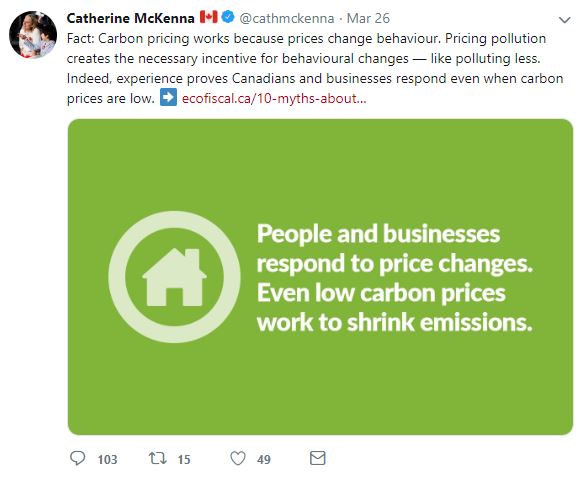
Canada’s Minister of Environment and Climate Change Catherine McKenna tweeted last Tuesday:
“Fact: Carbon pricing works because prices change behaviour. Pricing pollution creates the necessary incentive for behavioural changes — like polluting less. Indeed, experience proves Canadians and businesses respond even when carbon prices are low.”
The Canadian government has set the price of carbon at $10/tonne and hope to increase this by $10 per year to $50/tonne in 2022. This will lead to an annual price increase of 2.3 cents per litre of gas, and 2.7 cents per litre of diesel. Justin Trudeau hopes that this tax implementation will act as an incentive for car owners to make the switch to zero-emission vehicles.
The nation is torn in half with citizens who support the new carbon pricing, and citizens who do not. Is the Liberal government asking a bit much of Canadians to stop buying gasoline? Not all Canadians can ride a bike or use public transit for their morning commute if they work out of the city, and not everyone can afford to buy a zero-emission vehicle.
On the other hand, the government has stated that they will be giving a tax rebate to families as an incentive to act against climate change. Line 449 on everyone’s tax return will give up to $307 back, which is the governments way of returning the extra money Canadian’s spent on the carbon tax.
The reaction of the nation to this large change may be a significant contributing factor of Trudeau’s success this fall in the upcoming federal election.
References
Armstrong, P. (2019, April 02). Carbon tax explained: Why higher prices could change our behaviour | CBC News. Retrieved from https://www.cbc.ca/news/business/carbon-tax-explainer-1.5081006
C. M. (2019, March 26). Fact: Carbon pricing works because prices change behaviour. Pricing pollution creates the necessary incentive for behavioural changes – like polluting less. Indeed, experience proves Canadians and businesses respond even when carbon prices are low. ➡️ https://t.co/TmTSBU4D8K pic.twitter.com/psVdpNPIRu. Retrieved from https://twitter.com/cathmckenna/status/1110669067856371712
Climate Change Canada. (2017, June 21). Pricing carbon pollution in Canada: How it will work. Retrieved from https://www.canada.ca/en/environment-climate-change/news/2017/05/pricing_carbon_pollutionincanadahowitwillwork.html
 McMillan Research